
Choosing a China Top Solar EV Charger Charging Station Supplier requires more than comparing prices and panel ratings. Buyers must examine engineering records, factory controls, certification documents, and service coverage. A reliable supplier should explain how solar panels, batteries, inverters, chargers, and energy-management software work together. The details matter.
Fatih Birol, Executive Director of the International Energy Agency, has said, “Solar is going to be the new king of electricity markets.” His statement reflects the growing role of solar power in transport infrastructure. However, solar generation changes with clouds, seasons, and location. A practical station therefore needs intelligent load control, battery storage, and grid backup when appropriate. Good design is not always the cheapest design.
This guide explores how Chinese manufacturers build and support a Solar Ev Charger Charging Station for commercial sites, fleets, hotels, and public parking areas. It considers charging speed, system efficiency, weather protection, remote monitoring, installation experience, and long-term maintenance. Buyers should also request real project references, test reports, warranty terms, and replacement-part plans. A bright product brochure proves little.
The strongest suppliers show measured performance under realistic conditions, including hot roofs, winter mornings, dust, and repeated charging cycles. Yet no supplier is perfect. Some specifications may look impressive but lack independent verification. Careful buyers should ask difficult questions before signing. That small effort can prevent expensive downtime and improve the station’s daily value.
Solar EV Charging Stations: Definition, Components, and Operating Principles
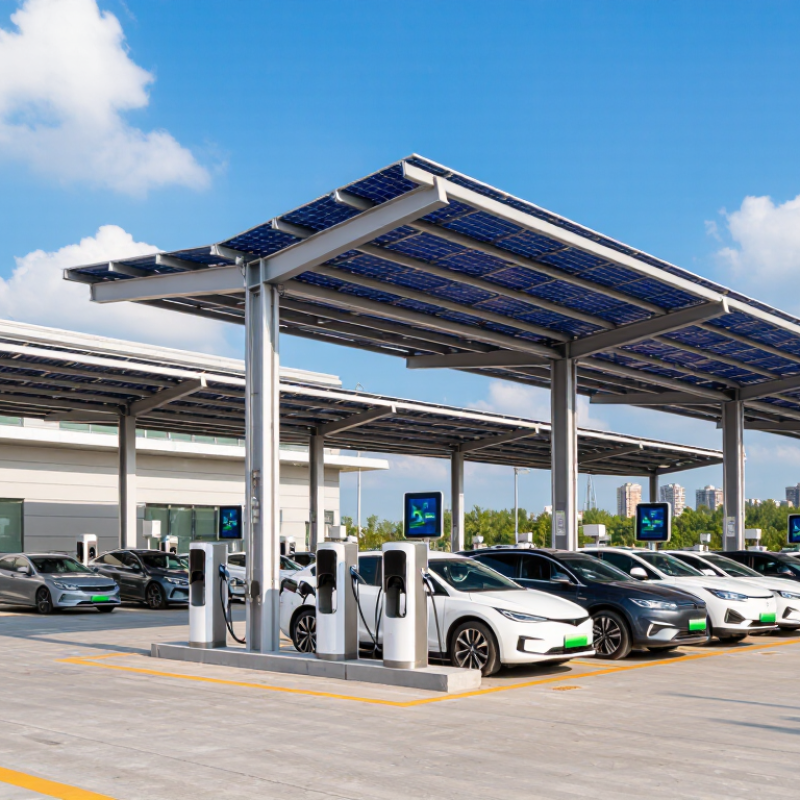
A solar EV charging station uses sunlight to produce electricity for electric vehicles. Unlike a conventional charger, it can generate power near the parking area. A typical system includes photovoltaic panels, mounting structures, an inverter, a charge controller, batteries, and an EV charging unit. It may also include meters, circuit protection, monitoring software, and a grid connection.
During daylight, photovoltaic panels create direct current electricity. The inverter converts it into usable alternating current for the charger and site equipment. Extra energy can charge the battery storage system. When an electric vehicle arrives, the charging unit controls voltage, current, and charging speed. If solar production is low, stored power or grid electricity can support charging. The exact sequence depends on system design.
Field installation requires more than placing panels above parking spaces. Engineers should check solar exposure, cable distance, drainage, wind loading, vehicle movement, and expected charging demand. A shaded panel row can reduce output noticeably. Battery temperature also affects performance and service life. No design is perfect. A small load estimate error may create long queues or unnecessary equipment costs. Regular inspection helps identify loose connections, dust buildup, software faults, and declining battery capacity. Clear operating records make later improvements more reliable.
Charging power varies by station design, grid connection, vehicle capability, and battery condition. AC Level 2 stations typically provide around 7.2 kW, while DC fast-charging systems commonly range from 50 kW to 350 kW. A solar EV charging station combines solar panels, an inverter, charging equipment, energy storage or grid connection, and a control system to manage power flow.
The values shown are representative rated-power levels for common charging equipment categories; actual output may vary.
The market is moving quickly. The IEA’s Global EV Outlook 2024 recorded more than 14 million electric car sales worldwide in 2023. Electric cars represented about one in five new vehicles sold. China contributed nearly 60% of global electric car sales, creating strong demand for reliable charging infrastructure.
Solar charging stations can reduce daytime grid pressure. IRENA reported 473 GW of renewable capacity additions in 2023, with solar providing the largest share. A practical station may combine rooftop panels, battery storage, smart energy management, and several charging points. At noon, solar power can support vehicles parked near an office, logistics yard, or roadside rest area. After sunset, stored energy may continue limited charging.
The numbers are encouraging. The IEA also reported that public charging points increased by more than 40% in 2023. Yet installation quality remains uneven. Cable protection, drainage, heat management, and regular maintenance often receive less attention than charging speed. That is a costly weakness.
Real-world performance depends on weather, parking time, battery capacity, and local grid limits. Solar output is not constant. Cloudy days expose this gap. A dependable station therefore needs accurate load calculations and clear operating data, not attractive claims alone. Field testing should measure daily energy yield, charging availability, fault rates, and battery aging. Some projects may still overbuild equipment before studying driver behavior. That deserves reconsideration.
China Top Solar EV Charger Charging Station Supplier
More than 1.6 TW of solar capacity was installed worldwide by 2023, according to IEA PVPS. This figure changes how EV charging infrastructure should be planned. Solar charging is no longer a small demonstration project. It is becoming part of wider energy systems.
A practical station may combine rooftop panels, a weather-resistant charger, and battery storage. At midday, panels can supply vehicles directly under clear skies. Excess power can charge batteries for evening use. The real output depends on location, panel angle, temperature, shading, and driver behavior. Numbers on a product sheet are not enough.
IEA PVPS reported that China added more than 200 GW of photovoltaic capacity in 2023. This rapid deployment has strengthened manufacturing experience across modules, power electronics, and charging equipment. IRENA also recorded solar as the largest source of new renewable capacity added globally in 2023. Still, solar charging has limits. A cloudy winter day can reduce generation sharply. Grid connection and storage may also increase project costs. A reliable supplier should provide test records, charging efficiency data, protection details, and after-sales support. Site measurements matter more than optimistic forecasts. Some projects may need a mixed energy design rather than a fully solar-only model.
China Top Solar EV Charger Charging Station Supplier
Choosing a China top solar EV charger charging station supplier requires more than factory scale. The IEA’s Global EV Outlook 2024 reports that China held almost two-thirds of the world’s public charging points in 2023. That scale supports mature sourcing, but output alone proves little. Ask for audited annual capacity, monthly shipment records, line testing, and spare-parts evidence. A large plant can still miss seasonal delivery windows.
Efficiency must be measured at the plug. Request separate figures for PV conversion, battery round-trip efficiency, charger efficiency, and standby consumption. NREL’s 2024 Best Research-Cell Efficiencies chart shows leading laboratory solar cells above 33%, while commercial modules perform lower. This gap matters. Shade, heat, dust, and cable losses can reduce daily energy more than brochures suggest. IEC 61851 and IEC 62196 alignment should be verified through test reports, not logos.
Warranty language deserves equal scrutiny. Require separate terms for the charger, battery, inverter, and solar modules, including response times and replacement procedures. ISO 15118 readiness may improve vehicle communication, but software updates and cybersecurity responsibilities must be stated. The IEA notes China’s charging network is expanding rapidly, while reliability remains a practical concern. I would inspect failure-rate data, protection tests, and a live installation before signing. No supplier is flawless. Honest gaps are often more useful than polished claims.
| Supplier Profile | Typical Charger Type | Rated Output | Annual Production Capacity | Peak Conversion Efficiency | Solar and Energy Management | Charging Standards | Safety and Compliance | Operating Temperature | Ingress Protection | Standard Warranty | Recommended Evaluation |
|---|---|---|---|---|---|---|---|---|---|---|---|
| Profile A | AC solar-integrated charging station | 7 kW or 11 kW AC | 1,000–3,000 units per year | 94%–96% | Solar-priority charging, scheduled charging, load balancing, and optional battery integration | IEC 61851-1; IEC 62196-2; GB/T 18487.1; GB/T 20234.2 | CE documentation available; overcurrent, overvoltage, residual-current, surge, and over-temperature protection | −20°C to +50°C | IP54 or higher for outdoor cabinet | 24 months | Suitable for residential and small commercial solar charging |
| Profile B | Commercial AC charging station with solar energy controller | 22 kW AC | 3,000–8,000 units per year | 95%–97% | Dynamic load management, photovoltaic surplus control, OCPP communication, and RFID access control | IEC 61851-1; IEC 62196-2; OCPP 1.6J; GB/T 18487.1 | CE and CCC product documentation; Type A or Type B residual-current protection depending on configuration | −25°C to +50°C | IP55 for charging unit; IK08 mechanical protection commonly available | 24–36 months | Strong choice for workplaces, apartments, and retail parking areas |
| Profile C | DC fast-charging station with solar and battery support | 30–60 kW DC | 500–2,000 units per year | 94%–96% | PV forecasting, battery peak shaving, remote monitoring, power-factor correction, and grid-interactive control | IEC 61851-1; IEC 61851-23; IEC 62196-3; OCPP 1.6J; GB/T 18487.1 | CE documentation; insulation monitoring, emergency stop, DC leakage detection, surge protection, and thermal monitoring | −20°C to +50°C | IP54 or IP55; outdoor versions generally include corrosion-resistant enclosure treatment | 24 months | Appropriate for fleet depots and medium-duty commercial charging |
| Profile D | High-power DC charging station with modular power units | 120–240 kW DC | 200–800 units per year | 95%–97% | Solar-plus-storage coordination, modular power sharing, demand-response capability, and cloud-based diagnostics | IEC 61851-23; IEC 61851-24; IEC 62196-3; OCPP 1.6J or 2.0.1; GB/T 18487.1 | CE documentation; emergency stop, insulation monitoring, connector temperature monitoring, overcurrent, and short-circuit protection | −30°C to +50°C with derating above the specified ambient temperature | IP54 or higher; IK10 cabinet protection may be offered for public sites | 24–36 months | Best suited to highway service areas, logistics hubs, and high-throughput fleets |
| Profile E | Solar carport charging system with integrated battery storage | 7–22 kW AC per outlet; site output up to 100 kW | 300–1,500 complete systems per year | 92%–95% system-level efficiency | PV generation, lithium battery storage, energy management system, backup operation, and export-limiting control | IEC 61851-1; IEC 62196-2; IEC 62933 series for applicable storage systems; OCPP 1.6J | CE documentation for applicable markets; battery thermal management, fire detection, isolation, and emergency shutdown | −20°C to +45°C, subject to battery-system derating | IP54 or higher for outdoor power equipment | 24 months for charger; battery warranty commonly handled separately | Recommended where solar self-consumption and peak-demand reduction are priorities |
| Profile F | Export-oriented AC/DC charging platform | 11–22 kW AC and 20–180 kW DC | 5,000–15,000 units per year | 95%–97% | Multi-language cloud platform, OCPP support, solar surplus charging, remote firmware updates, and payment integration | IEC 61851 series; IEC 62196 series; OCPP 1.6J or 2.0.1; ISO 15118 readiness may be available by model | CE documentation; EMC testing, residual-current protection, surge protection, and electrical safety test records should be requested | −25°C to +50°C | IP55 commonly available for outdoor models | 24 months, with extended plans available | Suitable for international deployments requiring software integration and remote service |
Solar-powered EV stations are expanding with electric vehicle adoption. The IEA reported over 4 million public charging points worldwide in 2023. Solar can reduce daytime grid demand, but weak planning creates unstable output and unsafe charging conditions.
Protection starts with physical details. Install residual-current protection, overcurrent devices, proper earthing, and emergency isolation. Enclosures should resist rain, dust, heat, and accidental impact. IEC 61851 guides conductive charging systems, while IEC 62196 covers charging connectors. ISO 15118 supports communication between vehicles and charging equipment. Local electrical codes still control the final installation.
The grid connection needs equal attention. Smart charging can shift vehicle demand toward strong solar production hours. Energy meters, export limits, and remote monitoring help prevent voltage problems. Battery storage may support evening charging, although it adds thermal and maintenance risks. The IEA expects charging demand to rise sharply through 2035, increasing pressure on distribution networks.
Field experience shows that ideal simulations often miss real behavior. Dust covers panels. Drivers arrive earlier than expected. A perfect design is unlikely. Suppliers should test load control, fault responses, and charging compatibility under local conditions. Operators also need documented inspections and trained maintenance teams. These practical checks protect users and improve long-term system reliability.
Global electric vehicle sales exceeded 14 million in 2023. Solar stations can support growing charging demand. They may also reduce daytime grid pressure.
A practical station may use rooftop panels, battery storage, smart controls, and multiple charging points. The design depends on parking time and local demand.
Yes, stored battery energy may provide limited evening charging. However, storage capacity, battery aging, and weather affect performance. It is not unlimited.
Solar production changes with clouds, heat, dust, and seasonal sunlight. Cloudy days can expose weak planning. Operators should measure actual daily energy yield.
Install residual-current protection, overcurrent devices, proper earthing, and emergency isolation. Enclosures should resist rain, dust, heat, and accidental impacts. Small details matter.
Smart charging can shift demand toward strong solar production hours. Energy meters and export limits help control voltage problems. Remote monitoring adds useful visibility.
No. Storage can support evening charging, but it adds thermal risks and maintenance work. A station may overbuild before studying driver behavior.
Field tests should measure charging availability, fault rates, energy yield, and battery aging. Teams should inspect cables, drainage, panels, and cooling systems. Perfect simulations are unlikely.
Solar Ev Charger Charging Station systems combine photovoltaic panels, inverters, energy storage, charging units, monitoring controls, and grid connections to supply clean electricity for electric vehicles. Their operating principle is straightforward: solar energy is converted into usable power, managed through intelligent controls, and delivered to vehicles directly or through batteries and the grid. With global EV sales exceeding 14 million in 2023 and worldwide solar capacity surpassing 1.6 TW, demand for reliable solar charging infrastructure continues to grow.
When evaluating Chinese suppliers, buyers should compare production capacity, charging efficiency, product quality, certifications, warranty coverage, and after-sales support. Safety features, overload protection, weather resistance, energy management, and compatibility with recognized charging standards are also essential. A dependable supplier should provide flexible grid-integration options, stable performance under varying sunlight conditions, and solutions suitable for commercial, public, and fleet applications. These factors help organizations select efficient, compliant, and durable solar charging stations for long-term clean transportation development.
