
Choosing the China best Mobile Charging Station Dc supplier requires more than comparing factory prices. Buyers need reliable equipment, clear technical documents, and responsive communication after delivery. A supplier may offer an attractive quotation, yet weak testing records can create expensive problems later.
This introduction examines how international buyers can evaluate Chinese suppliers of Mobile Charging Station Dc products. It considers charging power, battery capacity, connector compatibility, mobility, weather protection, and emergency operation. Practical details matter. Can the unit charge several vehicles during a busy event? Can two workers move it safely across uneven ground? Does the display remain readable under strong sunlight?
Experienced buyers should request product samples, inspection reports, warranty terms, and spare-parts lists before signing an order. They should also verify applicable safety certifications and confirm whether the equipment meets destination-market requirements. A professional supplier should explain installation, maintenance, software updates, and expected charging performance without hiding limitations.
Trust develops through evidence.
However, no supplier is perfect. Even a capable manufacturer may face shipping delays, component shortages, or communication gaps. Buyers should discuss these risks openly and record agreed solutions in writing. Factory visits, video inspections, and third-party quality checks can strengthen confidence. They cannot replace careful judgment.
The following outline explores supplier experience, product quality, customization ability, pricing transparency, and after-sales support. It also highlights questions buyers often overlook, including noise levels, charging efficiency in cold weather, and battery replacement procedures. A balanced evaluation helps buyers select a dependable partner, not merely the lowest-cost option.
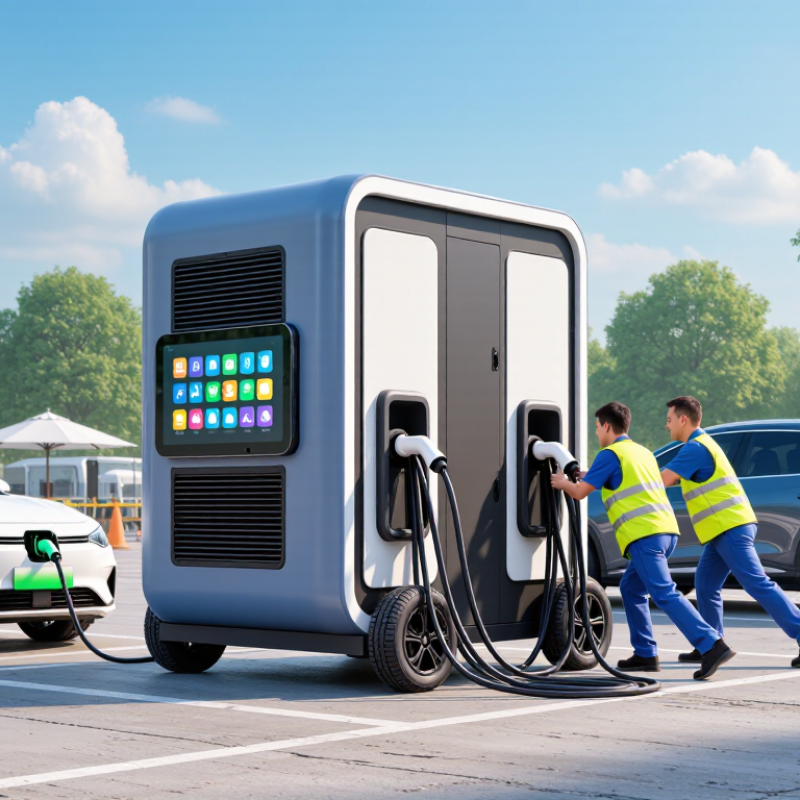
A mobile DC charging station is a transportable power unit for electric vehicles. Unlike fixed AC equipment, it stores electricity in a large battery pack and sends DC power directly to an EV battery. A wheeled cabinet, lifting points, display, cooling fans, and charging cable are common features. Some models use a towable trailer for larger battery capacity. The key benefit is flexibility.
At a roadside event, service depot, or temporary parking area, operators can move the unit close to a vehicle. The charger checks voltage, current, connector status, and battery temperature before delivering power. This controlled process reduces avoidable faults, although it cannot solve every grid or vehicle problem. Buyers should inspect output power, battery capacity, connector types, recharge time, weather protection, and emergency shutdown functions. A 60-kilowatt unit may charge faster than a small 20-kilowatt model, but it also needs heavier handling and stronger input power.
From practical evaluations, clear screens and long cables often matter more than glossy panels. Technicians need simple fault codes, stable wheels, and accessible service points. I once underestimated recharge time after several vehicles arrived together. That mistake showed an important limitation: mobile does not mean unlimited. Reliable suppliers should provide test records, safety documentation, warranty terms, and local service support. Buyers should also confirm compliance with applicable electrical and transport regulations.
| Data Dimension | Typical Specification or Fact | Buyer Relevance | Verification Point |
|---|---|---|---|
| Definition | A mobile DC charging station is a transportable battery-and-power-conversion system that supplies direct current to an electric vehicle without requiring a permanently installed high-power charger. | It can provide temporary or emergency charging where grid capacity or fixed charging infrastructure is limited. | Confirm whether the unit is designed for vehicle charging, battery storage, or both. |
| Rated DC Output Power | Common mobile systems are available in approximately 20–60 kW classes; larger trailer-mounted systems may exceed 100 kW. | Higher output power generally reduces charging time but increases system weight, cooling requirements, and cost. | Check continuous output power, not only peak power. |
| Usable Battery Capacity | Typical portable units range from about 20–100 kWh of nominal battery capacity. Usable energy is lower than nominal capacity because of reserve limits and conversion losses. | Capacity determines how many vehicles can be supported before the unit must be recharged. | Request nominal capacity, usable capacity, depth-of-discharge limit, and warranty cycle rating. |
| Approximate Charging Energy | A 30-minute session at a sustained 40 kW output delivers approximately 20 kWh before accounting for charging losses and vehicle tapering. | This may add roughly 100–130 km of driving range for an efficient passenger EV, depending on vehicle consumption and conditions. | Actual range added depends on battery temperature, vehicle efficiency, state of charge, and charging curve. |
| Input Charging Method | Units may recharge from AC grid power, a lower-power AC outlet, another charging point, or a dedicated energy source, depending on design. | A fast DC output does not necessarily mean the mobile unit itself can recharge quickly. | Verify AC input rating, maximum recharge time, plug type, and whether simultaneous charging and discharging are supported. |
| Vehicle Connection | The connector must match the vehicle and target market. Common regional DC charging interfaces include CCS-type, GB/T, and other region-specific configurations. | Connector compatibility determines whether the station can serve the intended vehicle fleet. | Confirm connector standard, cable length, current rating, communication protocol, and adapter policy. |
| Output Voltage and Current | Many passenger EV systems operate across a broad DC voltage range, commonly around 200–1,000 V, with output current selected according to the vehicle and charger design. | A wider voltage range improves compatibility across different vehicle battery systems. | Check minimum and maximum voltage, continuous current, and automatic vehicle negotiation. |
| Mobility Format | Available formats include wheeled portable cabinets, pallet-mounted systems, and trailer-mounted battery units. | The format affects transport requirements, deployment speed, parking space, and site access. | Review total weight, dimensions, wheel or trailer requirements, lifting points, and ground clearance. |
| Typical Applications | Emergency roadside charging, vehicle dealerships, fleet depots, construction areas, temporary events, remote facilities, and peak-demand support. | Mobile equipment can be relocated as demand changes without installing a new fixed charger at every site. | Match the product duty cycle and environmental rating to the intended operating location. |
| Safety Functions | Important functions may include over-voltage, over-current, short-circuit, over-temperature, insulation, ground-fault, emergency-stop, and battery-management protection. | Protection systems reduce electrical and thermal risks during transport, charging, and storage. | Request test reports, protection thresholds, emergency-stop behavior, and applicable conformity documentation. |
| Battery Chemistry | Lithium iron phosphate cells are widely used in stationary and mobile energy-storage applications because of their thermal stability and cycle-life characteristics. | Cell chemistry affects energy density, weight, safety behavior, service life, and operating temperature range. | Confirm cell specification, battery-management system, thermal management, and transport documentation. |
| Environmental Conditions | Outdoor-rated equipment commonly specifies an operating temperature range, humidity limit, dust and water ingress rating, and maximum altitude. | Environmental ratings determine whether the station can operate safely outdoors or in harsh industrial locations. | Verify the tested enclosure rating, cooling method, corrosion protection, and cold-weather performance. |
| Relevant Technical Standards | Product requirements may involve IEC 61851 for conductive charging systems, IEC 62196 for vehicle connectors, and applicable local electrical, battery, transport, and electromagnetic-compatibility regulations. | Standards help buyers compare safety, interoperability, and compliance claims across suppliers. | Ask for certificates issued for the exact model and target sales region, not only general declarations. |
| Best Supplier Evaluation Criteria | Compare verified output power, usable capacity, connector compatibility, safety documentation, after-sales support, spare parts, software functions, delivery capability, and total cost of ownership. | The lowest purchase price may not provide the lowest operating cost or the best fleet availability. | Use a standardized request-for-quotation sheet and require performance testing before bulk procurement. |
Note: Specifications shown are indicative industry ranges for buyer comparison. Final performance depends on the exact model, vehicle, battery state, ambient conditions, applicable regulations, and certified test results.
How Does a Mobile DC Charging Station Work?
A mobile DC charging station stores electricity in a high-voltage battery pack. Its battery management system monitors cell voltage, temperature, and remaining capacity. Power electronics then regulate current and voltage for the vehicle. Unlike an AC unit, it does not rely mainly on the car’s onboard charger. It sends controlled direct current to the traction battery through a compatible connector.
The process begins with communication between the station and vehicle. The system checks battery condition, charging limits, grounding, and connector status. IEC 61851 describes key control and safety requirements for conductive charging. If the vehicle accepts power, contactors close and charging starts. Thermal sensors can reduce output when cables or battery modules become too hot. Small details matter.
The stored battery is usually recharged from an AC supply, solar system, or another approved electrical source. The International Energy Agency reported more than four million public charging points worldwide at the end of 2023. It also recorded roughly 75% growth in fast chargers during that year. This supports demand for flexible charging equipment, especially at roadside events, construction areas, and temporary fleet depots.
However, rated output is not the same as real charging speed. Heat, battery temperature, cable length, and state of charge can reduce performance. A specification sheet may still mislead. Buyers should test energy efficiency, standby consumption, emergency shutdown, noise, and recharge time under realistic conditions. A mobile station that looks powerful may recover slowly between vehicles. That weakness deserves attention.
When comparing a China-based mobile DC charging station supplier, output performance deserves close attention. Check rated power, charging speed, connector options, and compatibility with different electric vehicles. A unit may advertise high output, yet deliver less power during hot weather. Ask for independent test reports, safety certifications, and clear electrical specifications. Ask for proof.
Portability matters. Examine wheel quality, handle strength, cable storage, and total weight before ordering. A practical station should move across concrete, ramps, and uneven parking areas. Battery capacity also affects working hours, recharge time, and transport planning. Look for thermal protection, overload control, weather resistance, and emergency shutoff functions. Small details can prevent expensive downtime.
Supplier reliability requires more than a polished website. Review production experience, quality-control procedures, spare-parts availability, warranty terms, and technical response times. Request factory inspection videos or sample testing before placing a large order. Field evaluations often reveal loose connectors, unclear screens, or slow software updates. No supplier is perfect. A transparent supplier should admit limitations and explain corrective actions. Compare delivery records, packaging quality, training materials, and after-sales support. The cheapest proposal may become costly when replacement parts arrive late.
China has become a major source of mobile DC chargers because its electric vehicle supply chain is unusually complete. The IEA Global EV Outlook 2024 reported that China represented about 60% of global electric car sales in 2023. The same report noted that China held more than half of the world’s electric car fleet. This creates strong demand for portable charging equipment, power modules, cooling systems, and replacement parts.
Battery and power-electronics manufacturing also support competitive production. According to the IEA’s Global EV Outlook 2024, China accounted for around 75% of global battery cell manufacturing capacity in 2023. Buyers can often source chargers, cables, housings, control boards, and testing services from nearby factories. That shortens development cycles. It can also simplify technical changes for fleet operators and roadside service teams.
The practical details matter. A reliable mobile DC unit needs stable output, thermal protection, clear fault records, and compatible charging communication. Compliance with relevant IEC 61851 requirements should be verified through complete technical documents and test reports. Price alone is a weak filter. A low quotation may hide limited field testing, slower spare-part support, or unclear warranty terms. The data explains China’s manufacturing advantage, but it does not prove every supplier is dependable. Buyers still need factory audits, sample testing, and performance checks under heat, dust, and repeated charging cycles. That part is sometimes underestimated.
Choosing the best China-based DC charging station supplier requires more than comparing online prices. In field evaluations, I check engineering records, factory capacity, and after-sales procedures. Product photographs are not enough. Ask for rated power data, charging efficiency, protection functions, and full test reports. A reliable supplier should explain these figures clearly and provide traceable production information.
Visit the factory when possible. Observe assembly lines, cable testing, enclosure sealing, and final inspection. Request a sample unit before placing a large order. Test it under different temperatures and charging loads. Check connector durability, cooling performance, screen visibility, and emergency shutdown response. Small details matter. Vague technical answers are warning signs. Still, a polished factory tour can hide weak subcontracting. This possibility deserves careful verification.
Review certifications required in your target market, including electrical safety and electromagnetic compatibility documents. Confirm that certificates match the exact model, not a similar product. Discuss warranty length, spare-part availability, software support, and response times in writing. Clear service terms reveal operational maturity. Compare payment terms, lead times, packaging methods, and inspection rights. A low quotation may exclude installation guidance or replacement components. I once underestimated those costs, and the final budget changed quickly. Independent inspection before shipment can reduce this risk, although it adds time and expense. Supplier selection should also consider communication quality, because delayed technical answers can become costly during installation.
It is a movable power unit for electric vehicles. It stores electricity in a large battery pack. The unit sends DC power directly to a vehicle battery. Common parts include wheels, lifting points, cooling fans, a screen, and a charging cable.
It can support roadside events, service depots, and temporary parking areas. Operators move it close to a vehicle. A trailer model may serve larger sites. However, mobile does not mean unlimited.
Before charging, it checks voltage, current, connector status, and battery temperature. These checks reduce avoidable faults. They cannot repair every vehicle or electrical problem. Proper supervision still matters.
Compare rated power, battery capacity, connector types, recharge time, and cable length. Check weather protection and emergency shutdown functions. A 60-kilowatt unit may charge faster than a 20-kilowatt unit. It also needs stronger input power and heavier handling.
Examine wheel quality, handle strength, total weight, and cable storage. The unit should cross concrete, ramps, and uneven parking areas. Stable wheels help. Weak handles become a daily frustration.
Not always. Hot weather may reduce actual output. Ask for electrical specifications and independent test reports. Battery temperature, vehicle limits, and input power can also affect charging speed.
Look for thermal protection, overload control, weather resistance, and emergency shutoff functions. Clear fault codes help technicians respond faster. Accessible service points can shorten maintenance work. Small details may prevent expensive downtime.
Review production experience, quality-control procedures, spare-parts availability, warranty terms, and response times. Request factory inspection videos or sample testing before a large order. Check packaging, training materials, delivery records, and local technical support. A polished website proves very little.
Several vehicles may arrive before the unit fully recharges. I once underestimated this delay. That mistake exposed a practical weakness. Confirm working hours, recharge planning, and site power before deployment.
A Mobile Charging Station Dc is a flexible power solution designed to provide electric vehicle charging where fixed charging infrastructure is unavailable, overloaded, or still under development. Unlike permanent charging points, it can be transported to different locations and used for roadside assistance, temporary events, fleet operations, construction areas, and emergency support. Its operation typically combines a battery system, power conversion equipment, charging connectors, safety controls, and a monitoring interface to deliver controlled DC power directly to compatible vehicles.
When comparing suppliers, buyers should evaluate charging speed, battery capacity, portability, connector compatibility, protection features, operating temperature range, charging efficiency, software functions, warranty coverage, and after-sales service. China has become a major sourcing destination because of its extensive manufacturing capabilities, component supply networks, engineering expertise, and competitive production costs. To select the best China-based supplier, buyers should verify product certifications, factory quality systems, customization options, testing procedures, delivery reliability, technical support, and long-term maintenance capabilities. A careful comparison helps ensure the selected solution is safe, practical, durable, and suitable for its intended application.
